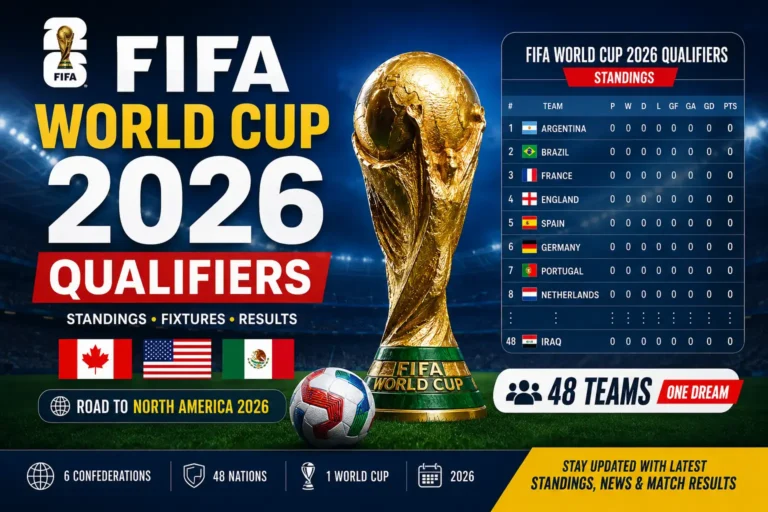
Every four years, the world watches the FIFA World Cup. But long before the opening ceremony, before the anthems and the packed stadiums, there is a journey — and that journey is called the FIFA World Cup Qualifiers.
For nations across six confederations, qualification is often tougher than the tournament itself. The road to the 2026 FIFA World Cup in Canada, Mexico and the United States is already one of the most competitive qualification cycles in history, largely due to the expansion to 48 teams.
Let’s break it down clearly.
What Are FIFA World Cup Qualifiers?
The FIFA World Cup qualifiers are a multi-year competition where national teams compete within their continental confederations to earn a place at the World Cup finals.
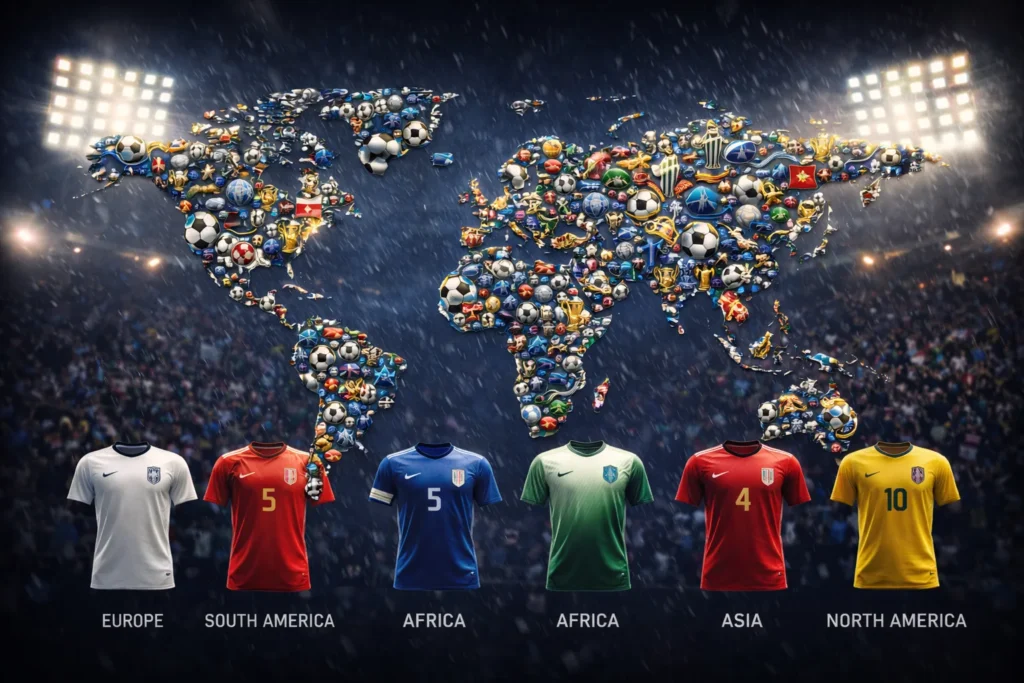
There are six confederations:
- UEFA (Europe)
- CONMEBOL (South America)
- CONCACAF (North & Central America)
- CAF (Africa)
- AFC (Asia)
- OFC (Oceania)
Each region has its own format, but all follow the same goal: secure one of the limited World Cup spots.
FIFA World Cup 2026 Qualification Format (48-Team Era)
The 2026 tournament is the first expanded edition with 48 teams, increasing opportunities across all continents.
Here’s how the slots are distributed:
| Confederation | Direct Spots | Play-off Spots |
|---|---|---|
| UEFA (Europe) | 16 | — |
| CAF (Africa) | 9 | 1 |
| AFC (Asia) | 8 | 1 |
| CONMEBOL (South America) | 6 | 1 |
| CONCACAF | 6 | 2 |
| OFC (Oceania) | 1 | 1 |
Additionally, there is an Intercontinental Play-off Tournament to determine the final places.
World Cup qualifying draw
| Group | Teams |
|---|---|
| Group A | Germany, Slovakia, Northern Ireland, Luxembourg |
| Group B | Switzerland, Sweden, Slovenia, Kosovo |
| Group C | Denmark, Greece, Scotland, Belarus |
| Group D | France, Ukraine, Iceland, Azerbaijan |
| Group E | Spain, Türkiye, Georgia, Bulgaria |
| Group F | Portugal, Hungary, Republic of Ireland, Armenia |
| Group G | Netherlands, Poland, Finland, Lithuania, Malta |
| Group H | Austria, Romania, Bosnia and Herzegovina, Cyprus, San Marino |
| Group I | Italy, Norway, Israel, Estonia, Moldova |
| Group J | Belgium, Wales, North Macedonia, Kazakhstan, Liechtenstein |
| Group K | England, Serbia, Albania, Latvia, Andorra |
| Group L | Croatia, Czechia, Montenegro, Faroe Islands, Gibraltar |
How Each Confederation Qualifies
UEFA (Europe)
Europe runs group stages followed by play-offs. Group winners qualify directly, while runners-up enter knockout play-offs.
Europe remains the most competitive confederation due to squad depth and tactical discipline.
CONMEBOL (South America)
South America uses a single league table format:
- All teams play each other home and away.
- Top teams qualify directly.
- One additional team enters the intercontinental play-off.
This format is arguably the toughest — no easy groups, just pure endurance.
CAF (Africa)
African qualification typically includes:
- Multiple group stages
- Top teams advancing
- Play-offs for final spots
African qualification is known for unpredictability and emerging talent.
AFC (Asia)
Asia uses a layered system:
- Preliminary rounds
- Group stages
- Final qualification groups
- Play-offs for additional opportunities
With the expansion, Asia now has its strongest representation ever.
CONCACAF
As hosts, Canada, USA and Mexico automatically qualify in 2026. Other nations compete through group phases and knockout rounds.
This region is growing rapidly in competitiveness.
OFC (Oceania)
Traditionally limited to a play-off path, Oceania now receives at least one direct slot — a historic development for the region.
Why World Cup Qualifiers Are So Intense
In my 30 years covering international football, I’ve learned this truth:
Qualifiers test mentality more than talent.
Players travel across continents.
Climates change.
Pitches vary.
Crowds intimidate.
And unlike the World Cup itself, there is no neutral ground advantage.
Key Factors That Decide Qualification
1. Squad Depth
Modern calendars are brutal. Nations with strong benches survive long campaigns.
2. Away Form
Winning at home is expected. Qualifying teams steal points away.
3. Tactical Flexibility
Different opponents require different systems. Adaptability wins qualifiers.
4. Goal Difference
In tight groups, goal difference often separates dreams from heartbreak.
Intercontinental Play-offs Explained
The intercontinental play-offs involve teams from different confederations competing for the final World Cup spots.
These are single-elimination matches — high drama, no second chances.
Historically, these matches produce some of the most emotional moments in world football.
Frequently Asked Questions (FAQs)
How long do FIFA World Cup qualifiers last?
They typically run over two to three years leading up to the tournament.
How many teams play in World Cup 2026?
A total of 48 teams, the largest in history.
Which confederation has the most spots?
UEFA (Europe) with 16 direct qualification places.
Do host countries play qualifiers?
No. Hosts qualify automatically.
Final Thoughts
The FIFA World Cup qualifiers are where football dreams are forged — and shattered.
Before the global spotlight, before the trophy lift, there are cold nights in Eastern Europe, humid battles in South America, and passionate clashes in Africa and Asia.
Qualification is not glamorous.
It is relentless.
It is unforgiving.
And that is why it matters.