When the referee blows the opening whistle on June 11, 2026, it will not just be 48 nations stepping onto the biggest stage in sport. Behind every stadium banner, every broadcast cut, and every digital touchpoint stands a carefully assembled roster of global brands — each one betting that alignment with football’s most-watched event is worth hundreds of millions of dollars. And by every commercial measure, they are probably right.
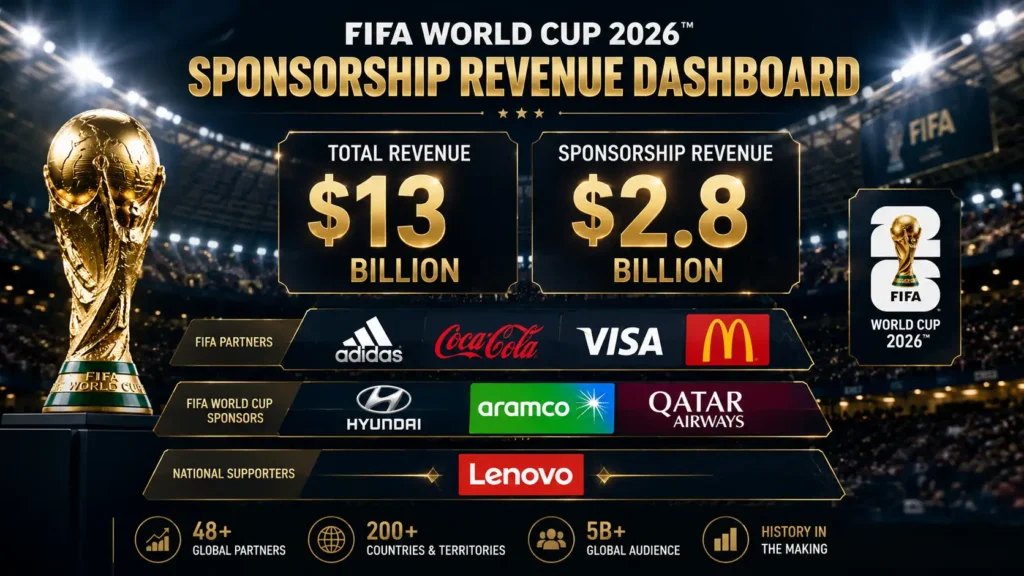
FIFA World Cup 2026 is not only the largest edition of the tournament ever staged — spread across 16 cities in Canada, Mexico, and the United States, with 104 matches on the schedule — it is also the most commercially ambitious. FIFA projects total revenue of $13 billion from this cycle, with an estimated $2.8 billion coming from sponsorship alone. That is a 56% jump over the $1.8 billion raised ahead of Qatar 2022. Brands are not just participating in the World Cup. They are funding its expansion.
So who is spending, how much do the tiers actually mean, and what does each brand’s involvement tell us about where football’s commercial power is headed? Let’s break it down properly.
How FIFA Structures Its Sponsorship Programme
Before listing the brands, it is worth understanding how FIFA’s commercial hierarchy works — because not all sponsors are equal, and the tier a brand occupies determines the scope of what they can actually do with the partnership.
FIFA organises its commercial relationships into three primary levels:
FIFA Partners sit at the top. These are long-term, multi-year global relationships that grant the broadest range of rights across all FIFA competitions, not just the World Cup. Think of these as the founding pillars of FIFA’s commercial model.
FIFA World Cup Sponsors are one rung below. Their rights are typically locked to a specific edition of the tournament and may be restricted to particular categories or territories.
Regional Supporters are the third tier — narrower in scope, often market-specific, and more transactional in nature.
This structure matters because it shapes what each brand can actually show in its advertising, where it can activate at venues, and how prominently it appears in FIFA’s global broadcast output.
FIFA Partners: The Top-Tier Global Brands
These are the brands with the deepest, most integrated relationships with FIFA. Their investment is not measured tournament-by-tournament but across years and competitions.
Adidas
The German sportswear giant has been intertwined with FIFA for decades, and 2026 is no different. Adidas serves as the official match ball partner — every goal, every save, and every moment of skill is executed with an Adidas ball — and is the official sportswear partner for the tournament’s on-field identity. This is not just logo placement. Adidas designs the match ball used in every single one of the 104 games, giving it an unrivalled product visibility that no broadcast camera can avoid.
Hyundai-Kia
The South Korean automotive group holds the official mobility partnership, meaning it supplies vehicles for tournament logistics, VIP transport, and official fleet operations across all three host nations. For a tournament spanning this many cities and time zones, that is a significant logistical undertaking — and a highly visible one.
Visa
Payments infrastructure is a critical operational requirement for a tournament of this scale. Visa is the exclusive payment technology partner, meaning its network underpins official FIFA ticketing, merchandise, and commercial transactions. In practical terms, Visa’s branding sits at every point of sale where money changes hands within FIFA’s ecosystem.
Qatar Airways
The Doha-based carrier retains a prominent position as official airline partner, having built a strong relationship with FIFA during the Qatar 2022 cycle. As the national carrier of the previous host nation now backing the next edition, its continued presence reflects both commercial logic and diplomatic continuity.
Aramco
Saudi Arabia’s state oil company secured a position as FIFA’s exclusive energy partner in a deal that runs through 2027 and covers multiple FIFA competitions. Aramco’s entry into football sponsorship at this level is one of the defining commercial stories of this era — it signals both the Gulf’s ambition to embed itself in global sport and FIFA’s comfort with energy-sector partnerships irrespective of the wider climate conversation in football.
Coca-Cola
Few brand-sport associations are as historically durable as Coca-Cola and FIFA. The American beverages giant is the official non-alcoholic beverage partner of the tournament, a relationship that stretches back to 1978. Its presence in stadium concourses, broadcast boards, and official tournament venues is almost ambient at this point.
Lenovo
The Chinese technology multinational holds the official technology partner designation, covering computing and digital infrastructure support across the tournament’s operational backbone. This is a partnership that has grown in strategic value as FIFA’s data and broadcast technology requirements have expanded significantly.
FIFA World Cup 2026 Sponsors: The Second Tier
This group of brands holds official World Cup sponsor status — significant commercial rights, but scoped more specifically to this tournament rather than FIFA’s entire competition calendar.
Bank of America brings major US financial services firepower to the tournament, particularly relevant given that the United States is the primary host nation and the expected centre of gravity for the event’s commercial activity.
AB InBev covers the alcoholic beverages category through its portfolio of brands — Budweiser, Michelob Ultra, Modelo, and Stella Artois. Alcohol sponsorship at FIFA events has historically required careful navigation given certain host nation regulations, but across a three-country tournament, AB InBev’s activation opportunities are considerable.
Frito-Lay (Lay’s) continues its long association with football sponsorship. The PepsiCo snacks brand is one of the few non-beverage FMCG products to have maintained consistent presence at the World Cup level.
Hisense — the Chinese consumer electronics brand — has been aggressively expanding its football sponsorship portfolio in recent years. Its presence at 2026 follows visible activations at UEFA Euro and previous World Cup editions, positioning it against category rivals in key growth markets.
McDonald’s needs little introduction. The American fast-food giant is a FIFA stalwart, and its official restaurant partner status gives it category exclusivity at tournament venues and in FIFA’s marketing output.
Mengniu Dairy represents China’s continued commercial investment in the World Cup despite the national team’s absence from this edition. For Mengniu, the World Cup is a global brand-building exercise rather than a domestic patriotic play.
Unilever brings a broad consumer goods portfolio to the sponsorship. Its activation potential spans personal care, home care, and food brands across markets that align with the tournament’s global broadcast footprint.
Verizon is a distinctly American addition to this tier, capitalising on the US’s host nation status. Its telecommunications infrastructure and 5G network messaging is expected to be central to its tournament activation.
Regional Supporters: The Third Tier
This tier is more varied in nature, blending US-centric brands capitalising on host nation advantage with globally ambitious companies seeking the World Cup’s international platform.
| Brand | Category |
|---|---|
| Airbnb | Accommodation & Travel |
| Home Depot | Home Improvement Retail |
| DoorDash | Food Delivery |
| Marriott Bonvoy | Hotels & Hospitality |
| Diageo | Premium Spirits |
| Valvoline | Automotive Services |
| Salesforce | Enterprise Technology |
| Globant | Technology Services |
| Rock-It Cargo | Official Freight & Logistics |
| Public Investment Fund | Investment |
Airbnb’s position in this tier is worth examining in more detail. The company has gone public with its excitement about the tournament, stating it expects the World Cup to be the biggest hosting event in the company’s history — surpassing even the Paris 2024 Olympics. With approximately 400,000 fans expected to book through the platform, and direct integration into the FIFA ticketing app, Airbnb’s role here is more than a logo on a board. It is embedded into the fan journey from the moment a ticket is purchased.
Saudi Arabia’s Public Investment Fund (PIF) appearing as a regional supporter is a notable piece of context. It continues a pattern of Gulf sovereign wealth engagement with global football infrastructure at multiple levels simultaneously.
Official Suppliers
American Airlines holds official airline supplier status, distinct from Qatar Airways’ global partner role but significant given its domestic network across the United States — the most logistically complex of the three host nations in terms of stadium geography.
What the Sponsorship Landscape Actually Tells Us
A few things stand out when you step back and look at this commercial picture as a whole.
The US market is the engine of this sponsorship cycle. The number of major American brands — Visa, Bank of America, McDonald’s, Home Depot, DoorDash, Verizon, Airbnb, American Airlines — reflects both the commercial opportunity of hosting on US soil and FIFA’s deliberate strategy to deepen its roots in the world’s largest advertising economy. Football’s growth in the United States has been building for years. These brands are not just sponsoring a tournament; they are signalling belief in the sport’s long-term trajectory there.
China’s commercial presence exceeds its footballing one. Mengniu Dairy, Hisense, and Lenovo all represent Chinese commercial interests in a tournament where China’s national team is absent. For these brands, the World Cup is a brand-globalisation tool, and FIFA’s scale makes it uniquely efficient for reaching consumers across Europe, South America, and Asia simultaneously.
Gulf investment is now structural, not peripheral. Aramco, Qatar Airways, and the Public Investment Fund together represent a pattern of Gulf state-aligned capital embedding itself across football’s commercial architecture. This is a trend that has accelerated sharply since 2017 and shows no sign of decelerating.
The sponsorship revenue gap between 2022 and 2026 is significant. Moving from $1.8 billion to $2.8 billion in sponsorship revenue in one cycle suggests both that FIFA has successfully expanded its commercial inventory — partly through the expanded 48-team format — and that brands’ confidence in the World Cup’s audience reach has not diminished despite the fragmentation of global media consumption.
Final Thought
The FIFA World Cup 2026 sponsorship portfolio is a precise mirror of where commercial power in global football currently sits — concentrated in the United States, influenced heavily by Gulf capital, and increasingly dependent on technology and fintech brands that see live sport as one of the last remaining mass-audience environments where attention cannot be skipped.
Whether you are watching for the football or watching the business of football, what happens between June 11 and July 19, 2026 will be instructive on both counts.
FIFA World Cup 2026 runs from June 11 to July 19, 2026, across 16 host cities in Canada, Mexico, and the United States.